Relaxing City Days: An AI Checklist for Calm Hidden Gems
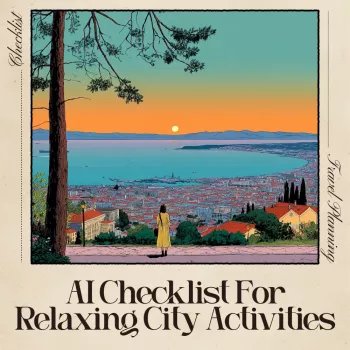
A Calm-City Game Plan: An AI-Powered Checklist for Relaxing Activities, Hidden Gems, and Low-Key Fun
Fast-paced itineraries can turn a trip into a sprint. A calmer approach focuses on recovery-friendly plans: quiet places, gentle movement, mindful moments, and flexible timing. This guide centers on a checklist method that helps spot relaxing activities in any city—without spending hours on reviews—so travel days feel lighter, more present, and easier to enjoy.
What “relaxing” looks like in a new city
Relaxation is less about the category of activity and more about the outcome: lower noise, fewer lines, shorter commutes, comfortable seating, and the freedom to leave whenever you want. Instead of trying to “see it all,” aim for a low-stimulation mix that still feels special: one nature moment, one cozy indoor option, one mindful activity, and one simple treat (tea, pastry, or a scenic bench).
Common stressors are predictable—back-to-back bookings, complicated transit transfers, peak-hour attractions, and long waits for food. A simple pacing rule keeps the day easy: one anchor activity per half-day, plus optional add-ons if energy is high. Set accessibility preferences upfront (walking distance limits, stairs avoidance, crowd sensitivity, and budget boundaries) so every choice supports your real comfort.
Relaxation signals to look for when picking activities
| Signal | What to search for | Why it helps |
|---|---|---|
| Quiet spaces | botanical garden, arboretum, library, meditation room, small gallery | Reduces sensory load and decision fatigue |
| Low-queue experiences | timed entry, reservations, off-peak hours, neighborhood spots | Protects limited energy and keeps plans flexible |
| Gentle movement | riverside walk, easy trail, mobility-friendly park loop | Supports mood and sleep without overexertion |
| Comfort-first venues | tea house, café with couches, slow brunch, book café | Creates built-in recovery time between activities |
| Micro-adventures | scenic viewpoint, local market, small museum | Delivers novelty without a full-day commitment |
How the AI-powered checklist approach works (in minutes, not hours)
Start with a calm-day goal: “restore,” “soft explore,” or “quietly celebrate.” That single decision makes the rest easier because you’re choosing activities that match your capacity, not just what’s popular. Then add your constraints: time windows, preferred neighborhoods, transit tolerance, walking limit, and crowd sensitivity.
Next, ask for options in tiers: “ultra-low effort,” “moderate,” and “backup if weather changes.” The tiering prevents overplanning while still giving you choices. Require a one-line reason each option is relaxing (quiet, seating, scenery, minimal planning), then verify critical details—hours, last entry times, reservation rules, and closures—on official venue pages.
Finally, convert the short list into a checklist you can actually use: entry requirements, a simple route plan, comfort items, and an “exit plan” if it’s busier than expected. If stress management is a priority, grounding your day in small, controllable decisions aligns with public health guidance on coping skills and stress reduction from sources like CDC and WHO.
The stress-free travel checklist (use before, during, and after each outing)
Before leaving: confirm opening hours, last entry time, and whether tickets are needed; save addresses offline. Do a route sanity check and pick the simplest path even if it’s slightly slower—especially during rush hour when multi-transfer routes multiply friction.
Mindful pacing: schedule a 15–30 minute decompression block after any stimulating place (market, transit hub, busy museum). Use a simple on-site rule: if it’s louder or more crowded than expected, switch to the fallback without guilt. After the outing, do a quick reflection: what felt restorative, what drained energy, and what to adjust tomorrow. For a refresher on small mindfulness habits that fit real life, Mindful’s basics are a helpful reference: Getting Started with Mindfulness.
Hidden gems without the hassle: simple filters that find calm
Mindful experiences that fit real schedules
Put it all together: a sample “low-key fun” day template
Digital guide pick: a ready-to-use AI checklist for calm travel days
If you want a reusable structure you can pull up for any destination, Your AI-Powered Checklist for Finding Relaxing Activities in Any City – Digital Guide, eBook, and Stress-Free Travel Checklist for Hidden Gems, Mindful Experiences, and Low-Key Fun is designed to keep planning fast and low-pressure. It’s built around energy-based filtering (ultra-low effort, moderate, weather backup), comfort preferences, and quick verification steps so calm options don’t get buried by hype.
For the “gentle movement” part of the day, comfortable walking shoes can make a quiet plan actually feel quiet—especially if you’re doing scenic loops or neighborhood wandering. Consider Alviero Martini Prima Classe Women’s Lace-Up Shoes for a polished option that still supports a walk-first itinerary.
And when the most restorative moment is the one you schedule after the trip, a cozy outdoor reset space can extend that calm at home. The 7-Piece PE Rattan Patio Furniture Set with Cushions, Modular Sectional Conversation Set is a comfort-forward way to build a low-key decompression zone for slow coffee, reading, or a post-travel unwind.
FAQ
How can relaxing activities be found quickly in a city that’s new?
Use a constraint-first checklist: choose a small neighborhood radius, off-peak times, and comfort requirements like quiet spaces and seating. Pull a short list in tiers (ultra-low effort, moderate, weather backup), then verify hours and reservations on official venue sources.
What should be packed for a low-stress day of exploring?
Bring a small comfort kit: water, a snack, layers, a portable charger, and earplugs or other noise reduction. Add a planned decompression break and identify a nearby fallback spot so you can exit crowds quickly.
How many activities fit into a calm itinerary?
Aim for one anchor activity per half-day with optional add-ons only if you feel good. Build in a 15–30 minute reset after anything busy and keep the plan flexible so weather or crowds don’t derail your day.













Leave a comment