Inheritance Inequality: 4 Guides + Checklist Bundle
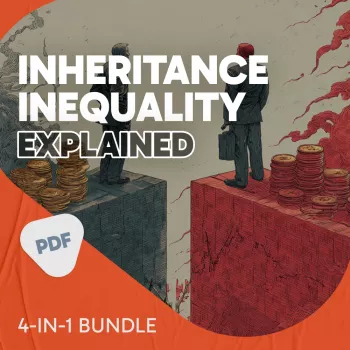
Inheritance Inequality Explained: A Clear, Practical Digital Bundle for Learning and Discussion
Inheritance can shape opportunities across generations—affecting housing options, educational pathways, business ownership, and long-term financial security. Yet the topic often feels abstract, emotionally charged, or tangled in legal and policy language. The Inheritance Inequality Explained | 4-in-1 Guides & Checklist Digital Download Bundle turns the big picture into a structured learning experience: plain-language guides paired with a checklist that supports reading, reflection, group discussion, or curriculum planning.
What inheritance inequality means
Inheritance inequality describes how uneven transfers of wealth—money, property, investments, or businesses—can widen gaps between families over time. These transfers are not limited to a single event at death. They can include bequests and trusts, but also inter vivos (during-life) gifts, help with down payments, or ongoing informal support such as tuition payments and living-expense coverage.
Even modest differences in starting resources can compound. Families who begin with assets may benefit from investment growth, access to higher-opportunity neighborhoods and schools, and greater willingness to take career risks (like entrepreneurship or unpaid internships) because there is a financial cushion. This topic intersects with estate planning, tax policy, housing markets, labor outcomes, and historical patterns that influence who accumulates wealth and how securely that wealth is held.
Why the gap can grow across generations
Intergenerational wealth differences can expand for several reinforcing reasons:
- Compounding returns: Inherited assets can appreciate, generate rental income, or produce dividends—accelerating growth compared to starting from zero.
- Reduced financial shocks: Families with assets may handle medical bills, job loss, or emergencies without resorting to high-interest debt or selling necessities.
- Opportunity access: Resources can fund tutoring, college, relocation for work, professional networks, or seed capital for a small business.
- Unequal exposure to debt: Without inherited support, households may rely more on student loans, credit cards, or high-cost borrowing, which can slow or reverse net-worth building.
For learners who want to ground the conversation in data, reputable reference points include the Federal Reserve’s Survey of Consumer Finances (SCF), the World Inequality Database (WID), and the OECD’s overview of inheritance taxation approaches.
What’s included in the 4-in-1 digital download bundle
This bundle is designed to help people move from vague awareness (“inheritance matters”) to clear understanding (“here are the mechanisms, incentives, and tradeoffs”). It includes four focused guides written in approachable language and a ready-to-use checklist that helps structure learning and conversation. Because it’s a digital delivery, it’s available quickly—download, save, and revisit without waiting for shipping.
Bundle components at a glance
| Component | Purpose | Best for |
|---|---|---|
| Guide 1 | Core definitions and the mechanisms of wealth transfer | Getting oriented quickly; shared vocabulary |
| Guide 2 | How inheritance shapes wealth distribution and mobility | Students; community discussions; civic learning |
| Guide 3 | Policy tools and tradeoffs (high-level overview) | Debates, presentations, or structured comparison |
| Guide 4 | Case-based thinking and real-world implications | Workshops; facilitation; deeper reflection |
| Checklist | Step-by-step path for reading, notes, and discussion prompts | Self-study plans; classroom pacing; group facilitation |
How to use the guides and checklist effectively
The materials work best when used as a paced sequence rather than a one-sitting read. A simple, repeatable approach:
- Start with definitions: Do a first pass and highlight unfamiliar terms (estate, trust, capital gains, net worth, intergenerational mobility).
- Use the checklist to set a cadence: Assign one guide per session, followed by a short reflection or discussion segment.
- Build a concept map: Connect mechanisms (inheritance, housing, education, taxation) to outcomes (wealth inequality, mobility, opportunity gaps).
- Pair with current events: Relate ideas to housing affordability, estate tax proposals, student debt, or philanthropic giving.
- For groups, assign roles: One person summarizes, one captures questions, and one links the reading to real-world examples.
Who this bundle is best suited for
- Educators and facilitators: Build lessons on wealth, inequality, or economic mobility with ready-made structure.
- Students: Learn intergenerational wealth transfer without getting lost in jargon or scattered sources.
- Community groups and book clubs: Use the checklist prompts to keep discussions grounded and respectful.
- Curious readers: Compare viewpoints and understand how policy choices can affect outcomes.
Practical download and printing tips
- Save a master copy locally and keep a backup in cloud storage for easy access across devices.
- If printing, use standard letter/A4 settings and test-print one page first to confirm margins and scale.
- For note-taking, consider printing only the checklist and using digital highlighting/annotations for the guides.
- If sharing in a classroom or group, confirm usage permissions and distribute files in a way that preserves formatting.
Using the material responsibly
Featured in-stock picks
- Inheritance Inequality Explained | 4-in-1 Guides & Checklist Digital Download Bundle (Digital download)
- Alviero Martini Prima Classe Women’s Lace-Up Shoes
- 7-Piece PE Rattan Patio Furniture Set with Cushions, Modular Sectional Conversation Set
FAQ
Is this bundle suitable for classroom or workshop use?
Yes. The guides and checklist support lesson pacing, structured sessions, and group discussion, and they also work well for independent study. If distributing copies to a class or group, confirm the usage permissions that apply to your purchase.
Does it cover both the concepts and the policy debates around inheritance?
It explains the mechanisms of wealth transfer and includes a high-level overview of common policy tools and tradeoffs. The emphasis stays on clarity and comparison rather than partisan framing.
How is the checklist meant to be used?
The checklist is a step-by-step organizer for reading, note-taking, reflection questions, and discussion prompts. It can be used to set a weekly plan, pace a unit, or keep a facilitated session focused and consistent.















Leave a comment